
Build your long-distance communication schedule around sleep and work first. Then choose one reliable live-call window, a backup and a way to leave messages without expecting an immediate reply. A three-hour gap may allow an evening call; a six-hour gap can need a lunch window or a weekend; a ten-hour gap may pair one person's morning with the other's evening.
The right routine depends on your actual availability, not just the number on the clock. Shift work, family responsibilities and commuting can make a small time difference harder than a large one. Start by writing down when each of you is genuinely free.
We make DreamDuo. These are planning examples, not rules about how often couples should talk.
Use the examples as planning templates, then check your own cities and dates. Once you have a call window, choose one of our 25 video-date activities.
Start with a shared availability map
Mark three kinds of time: asleep, working or unavailable, and awake with room for a call. Add commuting and care responsibilities to the unavailable block. A calendar that treats every waking hour as free will quickly disappoint both people.
For the examples below, both partners work Monday–Friday, 09:00–17:00 local time, and sleep 23:00–07:00. A lunch call is an optional exception, not assumed free time. Use your own hours in the downloadable planner.
The reference week starts Monday, November 9, 2026. The examples use Accra and Nairobi for three hours, London and Dhaka for six, and London and Brisbane for ten. London is on GMT in this reference week. Times below are calculated using the named cities' IANA time zones.
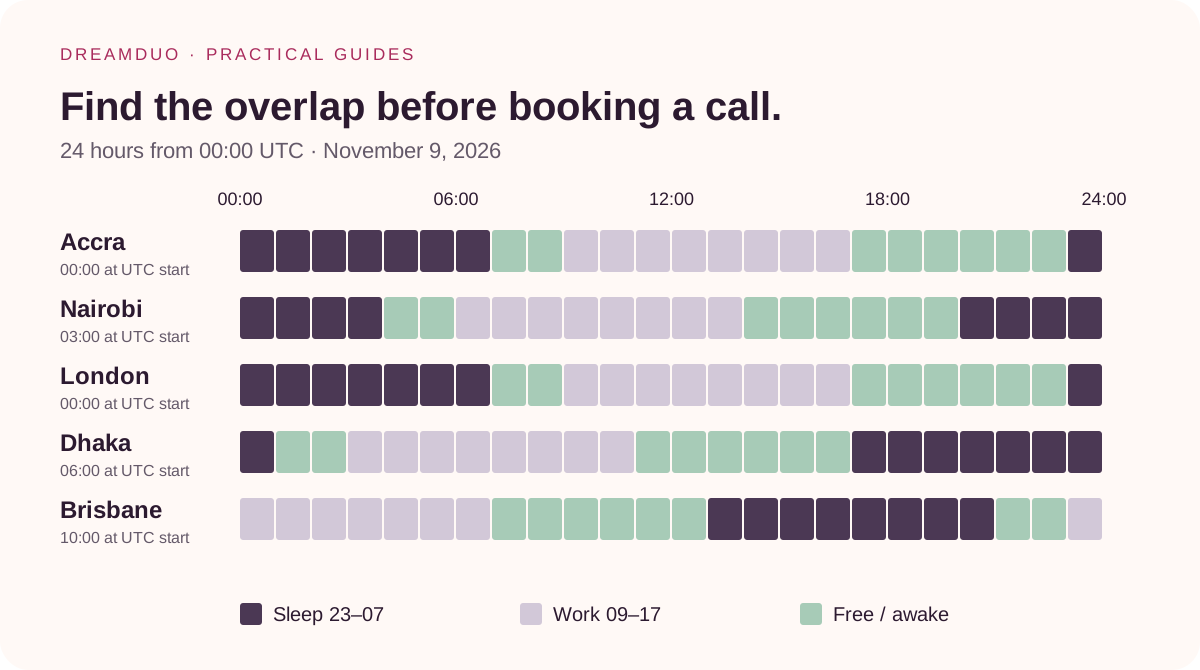
Find the overlap before booking a call.
Reference: November 9, 2026. Assume work 09:00–17:00 and sleep 23:00–07:00 in each place.
- 3 hours · Accra / Nairobi
- Free weekday overlap: 17:00–20:00 in Accra, 20:00–23:00 in Nairobi.
- 6 hours · London / Dhaka
- No free weekday overlap. A lunch call is optional if both schedules allow it.
- 10 hours · London / Brisbane
- Try 08:00 London / 18:00 Brisbane, or 21:00 London / 07:00 Brisbane the next day.
Routine 1: A three-hour difference
Example: Accra, Ghana (UTC+0), and Nairobi, Kenya (UTC+3). Under these assumptions, weekday free time overlaps from 17:00–20:00 in Accra / 20:00–23:00 in Nairobi. Choose a point inside that window rather than right at bedtime.
| When | Accra | Nairobi | Plan |
|---|---|---|---|
| Tuesday and Thursday | 19:00–19:20 | 22:00–22:20 | Short catch-up |
| Sunday | 15:00–16:00 | 18:00–19:00 | Longer call or shared activity |
| Busy weekdays | When convenient | When convenient | One message or voice note, reply later |
This routine keeps live calls away from work. The Nairobi partner still has time to wind down after the evening call. If 22:00 feels too late, move earlier within the overlap rather than asking them to keep stretching bedtime.
Backup: If someone misses Tuesday, use the same window Wednesday only if both want it. A missed call doesn't automatically create a second appointment or require an explanation in real time.
Routine 2: A six-hour difference
Example: London, UK (UTC+0 in the reference week), and Dhaka, Bangladesh (UTC+6). With the work and sleep blocks above, there is no shared free weekday window: when London finishes work at 17:00, it is already 23:00 in Dhaka.
You don't have to solve that by making one partner stay up. Try a short lunch overlap if it's genuinely available, and use the weekend for a longer conversation.
| When | London | Dhaka | Plan |
|---|---|---|---|
| Wednesday, if lunch allows | 07:30–07:40 | 13:30–13:40 | Optional ten-minute hello |
| Saturday | 10:00–11:00 | 16:00–17:00 | Main weekly call |
| Other days | Before work or after work | At a convenient local time | Voice notes with no live-reply expectation |
The Wednesday slot assumes the Dhaka partner can take a break during 13:00–14:00 and the London partner isn't commuting at 07:30. If either assumption fails, remove that call. The weekend appointment can stand on its own.
Backup: Agree on Sunday at the same local times for that reference week. Send a message before the Saturday call if you need to move it, where possible. Avoid leaving one person waiting while the other assumes the backup is obvious.
Routine 3: A ten-hour difference
Example: London, UK (UTC+0 in the reference week), and Brisbane, Australia (UTC+10). Weekday free time overlaps at 07:00–09:00 London / 17:00–19:00 Brisbane, and 21:00–23:00 London / 07:00–09:00 Brisbane the next day.
That second window is where calendar mistakes happen. A Monday-night call for one person is Tuesday morning for the other. Include both the local date and time in the invitation.
| When | London | Brisbane | Plan |
|---|---|---|---|
| Monday | Mon Nov 9, 08:00–08:20 | Mon Nov 9, 18:00–18:20 | Morning/evening catch-up |
| Thursday | Thu Nov 12, 21:00–21:20 | Fri Nov 13, 07:00–07:20 | Reverse the early/late roles |
| Saturday | Sat Nov 14, 09:00–10:00 | Sat Nov 14, 19:00–20:00 | Longer weekend call |
Alternating which person gets the early slot can spread the inconvenience, but only if both times fit your lives. A partner with an early commute may prefer a consistent evening call instead. Ask, rather than treating rotation as automatically fair.
Backup: Choose a second weekend slot and write both dates. If travel or shift work changes the week, check that slot again rather than assuming the usual ten-hour offset still describes where you are.
Check daylight saving before repeating the plan
These offsets belong to the reference week. London switches between GMT and British Summer Time, so its difference from Dhaka or Brisbane changes during the year. A recurring “08:00 London” call can move by an hour for the other partner even when your own clock time stays the same.
Use named time zones in your calendar, such as Europe/London, rather than labeling everything with a fixed UTC offset. Confirm the next call in both local times after a clock change or a trip. Check the UK government's clock-change information and Tourism Australia's time-zone guide for these examples. The IANA time-zone database is the underlying reference for the city-based calculations.
Make messages easy to receive later
Write a message that makes sense without an immediate response. “Here is the café I told you about; I'll send the menu after work” is easier to pick up later than three unanswered calls and “Are you there?” Agree on how you handle urgent situations separately from ordinary check-ins.
For conversations you want to return to, send one of these daily questions for long-distance couples. Leave your answer and let your partner respond in their own window. You can still discuss it during the next call.
The worksheet has spaces for each person's local work and sleep times, two possible call windows, a backup and a clock-change reminder. Fill it in together once, then revisit it when schedules change. It isn't an automatic converter.
When the routine stops fitting
Revisit the schedule before treating a missed call as a relationship verdict. Ask what changed: the time, the duration, the activity or the expectation of being available. You might need fewer live calls during a difficult work period, with a clear date to review the arrangement.
Our weekly relationship check-in template can help you discuss that change. If the next visit is the thing you're both looking forward to, use the visit planner and budget to turn it into a concrete next step.
Common questions
How do we communicate when there's no weekday overlap?
Keep the longer conversation for an agreed day off and exchange messages or voice notes at convenient local times. Add a brief lunch call only if both people actually have that break. Work time isn't automatically available just because someone is awake.
Should one person always stay up later?
Only if that person freely prefers the arrangement and it remains workable. Start with sleep as a protected block. If the plan depends on someone repeatedly losing sleep, look for a different time or format.
Can a calendar handle the conversion for us?
Many calendars display an event in each person's configured time zone. Still verify the local date, named zone and next occurrence, especially around clock changes. The printable schedules here are examples, not live time-zone calculations.
Keep reading

15-Minute Weekly Relationship Check-In: 12 Questions + Template
Use 12 weekly relationship check-in questions and a free worksheet to talk about appreciation, feelings, practical needs and one next step in 15 minutes.
Read the story
How to Plan Your Next Long-Distance Visit (Free Checklist + Budget)
Agree on dates, split costs and leave room to enjoy your next visit. Use a free long-distance visit checklist, editable budget and four-week plan.
Read the storyHow to Track Shared Goals as a Couple (Without Nagging Each Other)
Learn how to set shared goals as a couple, divide responsibilities, track progress and check in weekly without nagging each other.
Read the story