
Plan your next long-distance visit in this order: agree on a date window, decide who travels, set a total budget, then book the essentials. Give each task an owner and leave some of the visit unplanned. The checklist and budget below help you turn “We should see each other soon” into a plan you can both afford and enjoy.
This guide is for partners planning another visit after they've already met. A first in-person meeting needs its own decisions about safety, accommodation and independence. Here, the focus is dates, costs, responsibilities and time together.
We make DreamDuo, a shared-planning app for couples. The tools below work without it. All budget figures are fictional examples, not travel quotes.
Agree on the visit before choosing the tickets
Start with two possible date windows and the number of nights you can manage. Check leave, exams, family plans and the travel time on both ends. A three-night visit might require five days away if the journey is long.
Then decide who travels this time. Price matters, but so do shift patterns, accessibility needs, the energy needed for the journey and who has hosted recently. Alternating trips can be useful; it doesn't have to be a rule when your circumstances differ.
Before anyone books, answer these together:
- What is the most each of us can comfortably contribute?
- Where will we stay, and does the host need to check with anyone else?
- Are these dates confirmed or still waiting on leave?
- What would make the visit feel good to each of us: rest, activities, seeing friends, or a mix?
- What will we do if plans change before the trip?
A four-week visit-planning checklist
The four-week timeline is a starting point, not a booking deadline. Start earlier when the route, leave arrangements or entry requirements need more time. Confirm current travel requirements with the relevant official authorities before paying for international travel.
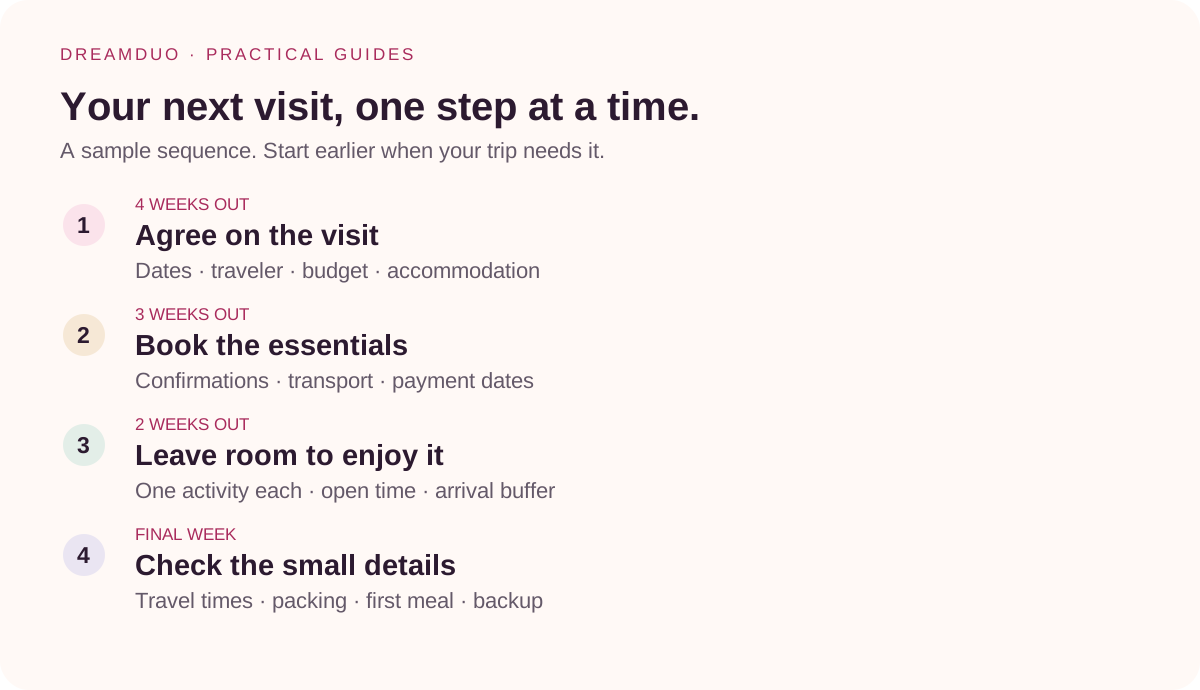
Your next visit, one step at a time.
A sample four-week sequence. Start earlier when your trip needs it.
- Four weeks out
- Make the decisions
- Three weeks out
- Secure the essentials
- Two weeks out
- Plan a little, leave room
- The final week
- Reduce last-minute decisions
Tick items as you plan. These checks stay in this page only and clear on reload; use the editable download to keep a copy.
Build a budget you both understand
Use one currency in the worksheet. If you pay in different currencies, agree on a reference conversion when you plan and revisit it before paying. Include fees and the costs around the journey, rather than treating the ticket price as the whole trip.
Here is a fictional USD example for a short visit, included only to show the calculation:
| Category | Example amount |
|---|---|
| Travel | $180 |
| Accommodation | $120 |
| Local transport | $30 |
| Food | $80 |
| Activities | $30 |
| Buffer | $60 |
| Total | $500 |
If you've already set aside $200, the gap is $300. With six weeks left, that is $50 per week between you, not $50 each. If one partner agrees to cover $180 of the gap and the other $120, their weekly amounts are $30 and $20. Choose amounts you can sustain; equal contributions aren't the only fair arrangement.
Don't book on the assumption that a future saving will definitely happen. If the total is uncomfortable, change the trip before changing your essential spending: fewer paid activities, different dates or a shorter visit may be options.
Make the split explicit
“We'll sort it out later” can mean different things to each person. Write down who pays for the booking, whether the other person reimburses them and when. Clarify whether accommodation is a shared cost or something the host is offering.
You can split equally, contribute different agreed amounts, or take responsibility for different categories. The useful part is agreeing before payment. Revisit the plan if either person's circumstances change rather than treating an earlier offer as a permanent obligation.
For a longer-term approach, our guide to tracking shared goals without nagging each other shows how to make the next action visible without repeated reminders.
Leave room for an ordinary day
If you've spent weeks waiting for the trip, it can be tempting to make every hour count. But travel is tiring, and being together may include laundry, a grocery run or one person needing an early night. Ask what each of you wants from the visit before filling the calendar.
Pick one anchor activity and one low-effort backup. Try our FaceTime activities while you wait for the visit. Our couples bucket list has ideas that can fit a small visit as well as a bigger trip. You can save the ambitious plans for another time.
Common questions
How far ahead should we plan a visit?
Start once you have a realistic date window and contribution you can each manage. This four-week checklist is an organizational example, not a claim that four weeks is the cheapest or sufficient lead time for every trip.
Who should pay for a long-distance visit?
There isn't one required split. Agree on who pays, what each contribution covers and whether reimbursement is expected before booking. Include the host's costs as well as the traveler's.
What if we can't agree on a budget?
Pause the booking and identify what is fixed and what can change. If you can't find a total that works for both people, postpone or redesign the visit. A date on the calendar is less useful than a plan you can both follow.
Keep reading

Long-Distance Relationships in Different Time Zones: 3 Weekly Routines
Build a long-distance communication schedule for a 3-, 6- or 10-hour time difference, with worked examples, sleep boundaries and a free weekly planner.
Read the storyThe 5 Best Couples Apps in 2026, Compared Honestly
Compare DreamDuo, Paired, Honeydue, Lasting and Between by features, pricing and use case. Find the couples app that fits what you want to do together.
Read the storyHow to Track Shared Goals as a Couple (Without Nagging Each Other)
Learn how to set shared goals as a couple, divide responsibilities, track progress and check in weekly without nagging each other.
Read the story