
A weekly relationship check-in is a short conversation about what felt good, what needs attention and one thing you'll do next. Set aside 15 minutes, put distractions away and take turns answering. Start with appreciation, discuss the week you actually had and finish with one manageable action. Use the 12 questions as a menu rather than an interview you must complete.
Use it in person, by phone or on video. Choose a few questions rather than rushing through all 12. If finding a shared time is the problem, start with our long-distance time-zone routines.
We make DreamDuo. This is an original editorial worksheet, not a therapy protocol or a promise of a relationship outcome.
The 15-minute plan
Agree that either person can pass on a question, ask for a pause or say they're too tired to do this well today. Try a time when you aren't already rushing out of the door. A recurring slot is useful only if it suits both people.
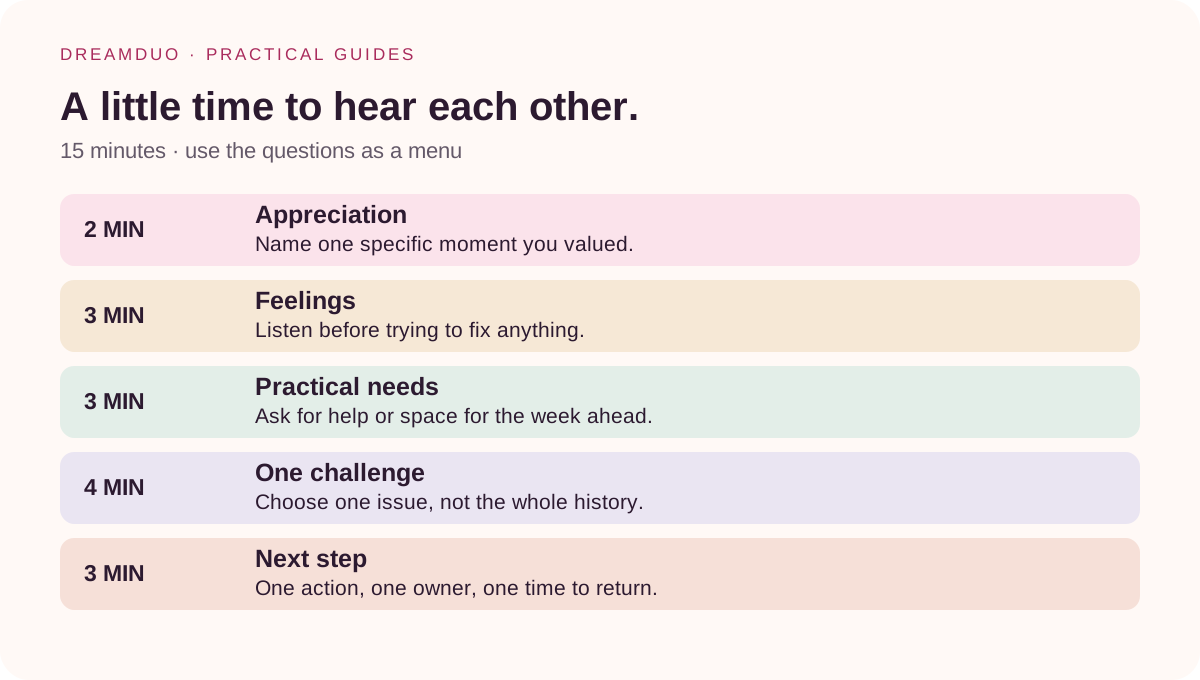
A little time to hear each other.
A suggested 15-minute plan. Use the questions as a menu.
- 2 minutes · Appreciation
- Name a specific moment you valued.
- 3 minutes · Feelings
- Listen before trying to fix anything.
- 3 minutes · Practical needs
- Ask for help or space for the week ahead.
- 4 minutes · One challenge
- Choose one issue, not the whole history.
- 3 minutes · Next step
- One action, one owner, one time to return.
| Minutes | Focus | What to do |
|---|---|---|
| 0–2 | Appreciation | Each name one specific thing you valued. |
| 2–5 | Feelings | Share how the week felt, without immediately trying to fix it. |
| 5–8 | Practical needs | Ask for the kind of help or space you need next week. |
| 8–12 | One challenge | Choose one issue; agree whether to act now or return to it. |
| 12–15 | Next step | Choose one action and something to look forward to. |
The timer is a boundary around the conversation, not pressure to speak faster. If one topic takes the whole session, you can leave the other questions for another week.
12 weekly relationship check-in questions
Start with appreciation
1. What did I do this week that helped you feel cared for? Ask for a concrete moment. “You checked whether I'd eaten before the late shift” tells you more than “You were nice.” Don't turn the answer into a request for more praise.
2. What ordinary moment with us would you like to repeat? It might be a walk, a voice note or cooking without looking at your phones. Pick something you actually enjoyed, not something you think a couple should enjoy.
Make room for how you feel
3. How are you arriving at this conversation today? Tired, hopeful, distracted or worried can all be useful answers. This gives your partner context before you interpret a quiet response.
4. When did you feel close to me this week, and when did you wish for more connection? Listen to both parts. You don't have to agree on the same moment to understand how it felt to the other person.
5. Do you want listening, reassurance or help with a decision right now? Ask before offering a solution. If the need changes during the conversation, check again rather than sticking to the first answer.
Ask for practical support
6. What is one thing next week that you want me to understand? Name a deadline, family visit or busy day. For long-distance couples, include when a usual call might be difficult.
7. Is there a task or responsibility we need to share differently? Choose the specific task, who owns it and what “done” means. “Help more” leaves more room for disagreement than “Can you book the train by Thursday?”
8. What kind of space or support would make next week easier? Space can be a useful request too. Be clear about what it looks like: an evening alone, a quiet check-in or a call after an appointment.
Give one challenge proper attention
9. Is there one moment from this week we should clear up? Stay with one event rather than collecting examples from the whole relationship. Describe what happened and how it landed for you.
10. What would you like us to try differently next time? Ask for a change that can be acted on. “Tell me if you'll be late for the call” is more usable than “Be more considerate.” If you can't agree now, write down the unresolved point and choose a time to revisit it.
End with a shared next step
11. What is one small thing we can each do before our next check-in? Keep it within the time and energy you actually have. One agreed action is enough; you don't need a new project every week.
12. What can we look forward to together? Choose a meal, a video date, a walk or a step toward your next visit. Something small and specific is easier to arrange than a vague promise to “do more.”
Fill in your check-in worksheet
Use these five spaces to note what you both said. You don't need to record every word. Agree on what you want to keep, and don't use the notes as a scorecard in a later disagreement.
An example of one useful next step
Here is a fictional example for partners living apart. One partner says a canceled Sunday call felt disappointing because they had set aside the afternoon. The other explains that a work change was confirmed late. They don't need to decide who cares more.
Their agreed step might be: “If Sunday changes, we'll send a message as soon as we know and suggest another time in both local time zones.” They then choose a short Wednesday call. That action addresses the practical problem without promising that plans will never change.
For partners sharing a home, the equivalent might be deciding who shops for dinner on a busy day, or protecting one evening without extra plans. The size of the action matters less than both people understanding it.
Keep the check-in from becoming another chore
Choose a few questions each week rather than working through all 12 every time. Let both people finish their answers. If you start rehearsing your reply while your partner is speaking, pause and check that you understood the point before giving your side.
If one topic keeps returning, a five-minute promise may not be enough. Agree on when to discuss it properly and what information you need first. The weekly worksheet can identify an issue; it doesn't have to contain the entire solution.
If one person doesn't want a formal check-in, ask whether a shorter walk or a single question would feel easier. Don't make completing the template a condition of being a good partner.
What to use between weekly check-ins
For lighter conversations, try the 30-day question calendar. For a practical project, our guide to tracking shared goals without nagging helps you define the next action. If you're looking for something enjoyable to plan, browse the couples bucket list.
Daily questions and check-ins serve different purposes. One helps you discover new things about each other; the other gives you room to discuss how the week is going. You can use either without making every conversation a relationship meeting.
Common questions
Do we have to check in every week?
No. Weekly is a suggested rhythm for this template. Try a pace that fits both people and review whether it helps. A missed session doesn't need to become another problem to solve.
Can we do it over text?
Yes, if both prefer that. Send one question at a time, leave room to think and agree on when you'll come back to the conversation. Don't interpret a delayed reply as an answer to the relationship question itself.
What if we disagree during the check-in?
Name the specific disagreement and ask whether you're both able to keep talking constructively. You can pause and choose another time. The aim of the 15-minute structure is a manageable conversation, not an obligation to resolve everything immediately.
Keep reading

Long-Distance Relationships in Different Time Zones: 3 Weekly Routines
Build a long-distance communication schedule for a 3-, 6- or 10-hour time difference, with worked examples, sleep boundaries and a free weekly planner.
Read the storyHow to Track Shared Goals as a Couple (Without Nagging Each Other)
Learn how to set shared goals as a couple, divide responsibilities, track progress and check in weekly without nagging each other.
Read the story
30 Daily Questions for Long-Distance Couples (When You Run Out of Things to Say)
Try a 30-day conversation challenge for long-distance couples, from funny questions to future plans. Includes a free printable question calendar.
Read the story